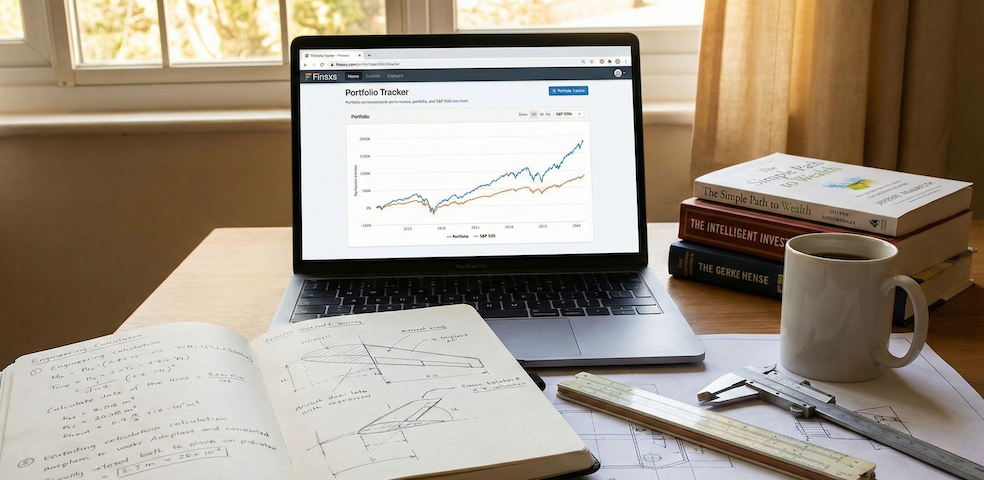
The Problem with Modern Investing
Modern investing has become increasingly complex. With assets scattered across different platforms stocks in one broker, crypto on various exchanges, and precious metals tucked away as insurance. It's nearly impossible to get a clear picture of your true financial performance. Traditional tools like spreadsheets can't handle the complexity of cross-asset tracking, while most portfolio apps treat crypto as an afterthought or ignore it altogether.
This fragmentation isn't just inconvenient; it's costly. Without a unified view of your investments, how can you accurately benchmark your performance against market indices? How do you know if your active trading is really beating the S&P 500, or if you're just fooling yourself? These questions haunted me as I juggled multiple platforms and struggled to maintain an accurate picture of my portfolio's health.
My Investment Evolution
The Wake-Up Call: Salary Isn't Enough
Like many professionals, I believed disciplined saving and smart salary negotiations were the keys to financial freedom. Then reality hit: true wealth accumulation doesn't come from income alone, it comes from owning assets.
This realization led me down an unexpected path. As an aerospace engineer trained to solve complex problems, I approached investing with the same methodical mindset. But instead of designing aircraft systems, I found myself studying market mechanics and asset allocation strategies.
Early Lessons: The School of Hard Knocks
My initial investment journey was humbling:
But perhaps the most valuable lesson came from John C. Bogle's work(#ad): the power of low-cost indexing. Warren Buffett's simple advice echoed in my mind: "Just buy the S&P 500." Yet, as I dug deeper into high-dividend ETFs, I discovered a concerning pattern many were dominated by just a handful of mega-caps.
The Macro Shift: A New Perspective
Post-2008 monetary policies and growing concerns about inflation led me to explore new asset classes:
This journey transformed my portfolio into a two-pronged approach: conservative assets for stability, and growth-oriented investments for upside potential.
My portfolio became bifurcated, a conservative base (metals as “insurance”) and growth assets on the other side. For me that growth side increasingly meant crypto. It delivered the upside I craved, but managing it was a nightmare. Stocks and ETFs in one broker, crypto across exchanges and wallets, swaps blurring cost basis. So I lost sight of average prices and true performance. Was I beating the S&P 500, or fooling myself? Spreadsheets helped a little, but multi-currency chaos and relative benchmarking were impossible. I had no single view of my net worth. I lost track of my average buying prices after countless swaps. And most importantly, I had the nagging question from J.L. Collins’ book "The Simple Path to Wealth"(#ad).
The Search for Better Solutions
Five years ago, I tried solving it myself. I built a database of tickers and ETF holdings, plus a basic web app for tracking. Watchlists worked early on, but transaction processing was difficult to solve. The development progress was slow and the result not satisfying then life (and children) got in the way. I shelved the project.
Then AI changed the game. With the help of modern AI coding tools, I dusted off the idea and I revived the project. I rebuilt the database (reusing my old data), focused on transaction accuracy, and prioritized what mattered most: a unified view across equities, ETFs, and crypto.
Introducing FinSxS
I called it FinSxS (Financial Side-by-Side) because the core philosophy is benchmarking; putting your assets side-by-side with the market to see the truth. It captures the core promise: normalized charts (base 100) so you can compare Bitcoin’s volatility to Apple’s stability or the S&P 500 without scale distortion. Relative performance becomes obvious. I built FinSxS for myself first, now finally seeing real portfolio performance against benchmarks, without app-switching or spreadsheet hell.
Core Features
The site launched with essentials for investors like me, mixed portfolios, multi-currency, and a desire for clarity.
The Road Ahead
FinSxS has just launched but I have lots of ideas to improve when it grows:
I built FinSxS primarily for myself, but with your feedback and usage, we can build the ultimate tool for the independent, engineering-minded investor. Privacy is non-negotiable: FinSxS is self hosted, encrypted, no data selling, full user control.
Join Me
If you’re tired of fragmented tools, juggling brokers, or wondering if your mixed portfolio beats the benchmark, give FinSxS a try.
Follow @Fin_SxS on X for updates. Your thoughts matter & let’s build this together.